
Stamp Duty Malaysia Guide for Property Buyers & Investors
Discover everything about stamp duty Malaysia — rates, exemptions, and property transaction costs explained in detail. Stay updated with 2026 guidelines to save on real estate investments.
Yip Tan
5/21/20268 min read
Stamp duty can feel like a hidden tax that pops up when you sign a contract. It’s a small cost that can become a big surprise if you don’t know the rules. In this guide we break down what stamp duty Malaysia is, how the rates work, who gets relief, and how to pay it in 2026. By the end you’ll know exactly what to expect and how to stay compliant.
Table of Contents
What Is Stamp Duty in Malaysia?
Stamp Duty Rates and How They Are Calculated
Exemptions, Reliefs, and Common Scenarios
How to Pay and File Stamp Duty in 2026 (Video Guide)
FAQ
Conclusion
What Is Stamp Duty in Malaysia?
Stamp duty is a tax on legal documents, not on the underlying transaction. The law calls the document an “instrument” , a written agreement, deed or license. When the instrument is stamped, the government records it and the paper becomes valid in court.
The tax is set out in the Stamp Act 1949. It applies to anything from a property sale agreement to a loan contract. If you forget to stamp, the document can’t be used as evidence and you may face a penalty.
In practice, the Inland Revenue Board (IRB) collects the duty. The duty amount depends on the type of instrument and, for some documents, the value involved. For example, a property transfer is charged at a progressive rate, while a simple lease might carry a flat fee.
Why does Malaysia use stamp duty? It provides revenue for public services and gives the tax authority a way to track high‑value deals. More importantly, it creates a legal record that protects both parties.
Foreign buyers often wonder if the rates differ. The answer is yes, a special 8% rate applies to residential property bought by non‑citizens, a change that took effect on 1 January 2026.
Stamp Duty Rates and How They Are Calculated
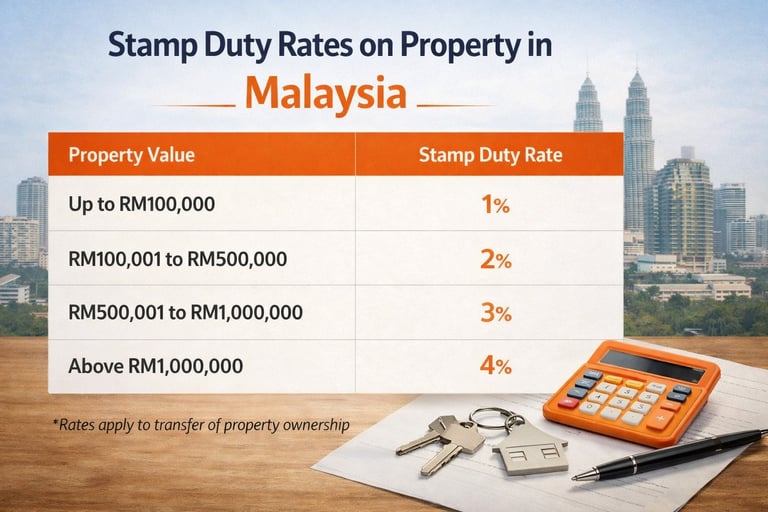
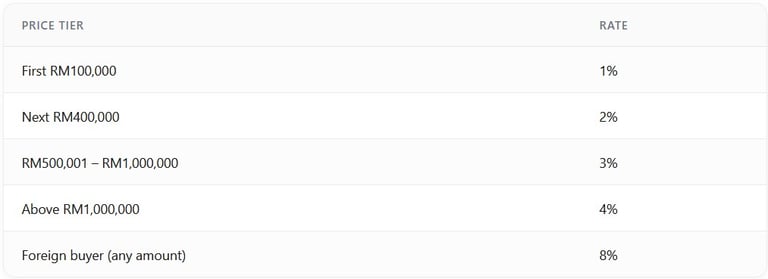
When it comes to property, Malaysia uses a tiered, progressive system. The first RM100,000 of the purchase price is taxed at 1%. The next RM400,000 carries a 2% rate. Anything from RM500,001 to RM1 million is charged 3%, and the amount above RM1 million is taxed at 4%.
For foreign buyers, the entire purchase price is taxed at a flat 8% rate, regardless of value. This higher rate was introduced to curb speculative buying and protect local affordability.
Here’s a quick snapshot of the current rates:
These rates apply to the “instrument of transfer” , the legal document that moves ownership. The duty is calculated on the market value or the agreed sale price, whichever is higher.
Other instruments have fixed or ad‑valorem duties. A loan agreement for a home purchase is generally charged at 0.5% of the loan amount. Cheques and contract notes carry a flat RM10 fee unless the amount is less than that, in which case a minimum of RM10 still applies.
To see the official description of the Stamp Act and its ad‑valorem provisions, refer to the Wikipedia entry Stamp duty. It outlines how the rates are structured and why they differ across instrument types.
After you know the amount, you have 30 days to pay. Late payment triggers a penalty of up to 20% of the unpaid duty, with a minimum fine of RM100.
Our own team at KLCC Investor often runs these calculations for clients to ensure they budget correctly before making an offer.
Exemptions, Reliefs, and Common Scenarios
Not every transaction faces the full stamp duty bill. The government provides several exemptions to encourage home ownership and ease the burden on certain groups.
First‑time homebuyers can claim a full waiver on both the transfer instrument and the loan agreement, as long as the property value is RM500,000 or less. The waiver applies to purchases made between 1 January 2021 and 31 December 2027. To qualify, the buyer must never have owned a residential property before, even as a co‑owner.
Another common relief is for employment contracts. Starting 1 January 2026, contracts where the employee earns RM3,000 or less per month are exempt from stamp duty. This expands the previous RM300 threshold and helps lower‑paid workers.
Family transfers , such as gifting a house to a spouse or child , may also qualify for exemption if the transaction meets certain conditions, like being a single‑unit transfer and not involving a market sale.
Corporate investors can sometimes claim a remission if the instrument is part of a restructuring that meets the IRB’s criteria. However, these cases require a formal application under Sections 15 and 15A of the Stamp Act.
For foreign investors, the 8% rate applies, but there is no blanket exemption. Some private advisory firms offer a “Foreign‑Buyer Edition” that helps calculate the duty and file the return, though the official portal remains the same.

Key Takeaway: Exemptions are limited to specific buyer profiles and price thresholds; always verify eligibility before signing.
How to Pay and File Stamp Duty in 2026
Starting 1 January 2026 the old Stamp Assessment and Payment System (STAMPS) is retired. All payments now go through the e‑Duti Setem portal on the MyTax website. The transition was announced by KPMG and the IRB in late 2025.
First, you need a MyTax account. Register with your NRIC or passport number, then activate the e‑Duti Setem service. The portal lets you submit a digital return, calculate the duty, and pay online via credit card, FPX or bank transfer.
When you log in, select “Stamp Duty” from the menu, then choose the instrument type , for example “Transfer of Property”. You’ll be asked to upload the signed instrument as a PDF. The system reads the value fields and auto‑calculates the duty based on the rates we covered earlier.
After the calculation, you confirm the amount and click “Pay”. A receipt is generated instantly. Keep the electronic receipt; you’ll need it when registering the property at the land office.
If you miss the 30‑day window, the portal will flag a late‑payment penalty. The new self‑assessment regime also introduced a fine of up to RM10,000 for deliberate false returns, but the IRB offered a one‑year concession on inadvertent errors made in 2026.
For a visual walk‑through, watch the short video below. It shows each click, from login to receipt download.
FAQ
What types of documents are subject to stamp duty in Malaysia?
Stamp duty applies to any written instrument listed in the First Schedule of the Stamp Act 1949. Common examples include sale and purchase agreements for property, memorandum of transfer, loan agreements, tenancy contracts, share transfer documents, and certain commercial contracts. Even a simple cheque can carry a flat RM10 duty if it exceeds the minimum threshold.
How long do I have to stamp a document after it is signed?
When the instrument is signed in Malaysia, you have 30 days to stamp it. If the document is signed abroad, the clock starts once the instrument arrives in Malaysia. Late stamping attracts a penalty of up to 20% of the unpaid duty, with a minimum fine of RM100.
Can I claim a stamp duty exemption if I’m buying my first home?
Yes, if the property price is RM500,000 or less and you have never owned a residential unit before. The exemption covers both the transfer instrument and the loan agreement. You must submit a statutory declaration confirming you meet the criteria. The exemption runs until 31 December 2027.
Do foreign investors pay a different stamp duty rate?
Foreign individuals and companies buying residential property face an 8% flat rate on the instrument of transfer, effective from 1 January 2026. This is higher than the progressive rates for Malaysian citizens and is designed to balance demand in the luxury market.
What is the new e‑Duti Setem system?
The e‑Duti Setem is an online portal on the MyTax website that replaces the old STAMPS system. It allows taxpayers to self‑assess, submit, and pay stamp duty electronically. You upload the signed instrument, the system calculates the duty, and you pay instantly. A digital receipt is generated for your records.
Are there penalties for filing an incorrect stamp duty return?
Under the new self‑assessment framework, a false or under‑paid return can attract a fine of RM10,000 or a penalty of up to 100% of the under‑paid duty. However, the IRB announced a one‑year concession for genuine errors made in 2026, so first‑time mistakes are forgiven if corrected promptly.
How can I ensure I don’t miss the filing deadline?
Set a reminder for the 25‑day mark after execution, keep all signed documents in a dedicated folder, and use the e‑Duti Setem portal’s “Save Draft” feature to preview the return before submission. For complex deals, consider having a tax professional review the return before you file.
Conclusion
Stamp duty Malaysia is a document‑based tax that every buyer, seller or lessee must reckon with. Knowing the rates, the exemptions and the new self‑assessment filing process lets you plan ahead and avoid costly penalties. Whether you’re a first‑time homeowner, a foreign investor, or a corporate entity, the rules are clear once you break them down.
We hope this guide gives you confidence to handle stamp duty without surprise. If you’re looking for deeper market insights or want help handling the e‑Duti Setem portal, explore our Luxury Homes in KLCC hub where we share data‑driven analysis and end‑to‑end support for high‑value property transactions.
Stay informed, keep your documents stamped, and enjoy the security that comes with a properly recorded deal.
Pro Tip: Keep the original instrument safe after stamping. You’ll need the stamped copy for any future sale or dispute.
For the official definition of stamp duty and the list of chargeable instruments, see the Malaysian Revenue Authority’s page Stamp Duty, LHDN. It explains which documents are covered and the legal basis under the third schedule of the Stamp Act.
We also advise investors to check the latest budget announcements. In 2026 the government raised the foreign‑buyer rate from 4% to 8% to balance demand and supply in the high‑end market.
Imagine you’re buying a luxury condo in KLCC. Without a stamped sale and purchase agreement, the transfer can be blocked at the land office. That delay could cost you rent and market exposure.
Key Takeaway: Stamp duty is a document‑based tax; without a stamped instrument the deal can’t be finalised.
Calculating the duty yourself can be tricky because you must round up to the nearest RM100 for each tier. A simple way is to break the price into the four buckets and apply the percentage to each slice.
Let’s walk through a sample calculation for a RM2.3 million condo bought by a local buyer:
First RM100,000 @ 1% = RM1,000
Next RM400,000 @ 2% = RM8,000
RM500,001‑RM1,000,000 @ 3% = RM15,000
Remaining RM1,300,000 @ 4% = RM52,000
Total stamp duty = RM76,000.
If the same buyer were a foreign investor, the duty would simply be 8% of RM2.3 million, or RM184,000, almost double.
Pro Tip: Use a spreadsheet to split the price into tiers; it reduces manual errors and speeds up the filing process.
"An unstamped instrument is not admissible as evidence in a Malaysian court.", Malaysian Stamp Act 1949.
Let’s say you’re a Malaysian buying a condo for RM450,000. Because the price is under the RM500,000 ceiling, you can apply for the first‑time buyer exemption, even though you’re not a first‑time buyer in the traditional sense. You’ll need a statutory declaration confirming you have never owned a residential unit before.
When filing for an exemption, you must submit a statutory declaration under the Statutory Declarations Act 1960 together with the stamped instrument. The declaration confirms eligibility and must be signed in front of a Commissioner for Oaths.
Failure to attach the declaration can result in a rejected exemption and a full duty assessment.