MM2H Requirements: Step‑by‑Step Guide
Discover the latest MM2H requirements for Malaysia My Second Home in 2026. Learn eligibility criteria, financial guidelines, and step‑by‑step application tips to secure long‑term residency in Kuala Lumpur.
Yip Tan
5/22/20267 min read
Malaysia’s sweet mix of modern cities, warm climate and low cost of living pulls many high‑net‑worth people to its shores. Yet the paperwork can feel like a maze. This guide cuts through the haze. You’ll see every requirement, the documents you need, where to pay, and how to land your visa without surprise delays.
By the end you’ll know exactly what to check, what to file, and how to move forward with confidence.
Table of Contents
Step 1: Verify Eligibility
Step 2: Gather Required Documents
Step 3: Submit Application & Pay Fees
Step 4: Attend Interview & Health Check
Step 5: Receive Visa Approval & Prepare Arrival
FAQ
Conclusion
Step 1: Verify Eligibility
First, ask yourself if you fit the basic profile. The program splits applicants into three tiers , Silver, Gold and Platinum , each with its own financial bar. Wikipedia’s overview of the My Second Home program notes that the government looks for stable income, good health and a clear intent to stay long‑term.
The age requirement is the biggest hidden lever. If you are 51 or older, you skip the 90‑day‑per‑year stay rule. That fact shows up in many YouTube explainers but is often missed in generic guides. For younger applicants, the 90‑day rule is strict , you must log those days each year.
Financial thresholds vary by tier. Silver asks for a US$150 k fixed deposit (some sources say US$500 k , the gap is real). Gold expects US$500 k, while Platinum moves up to US$1 M. The deposit sits in a Malaysian bank and can be partially withdrawn for approved expenses.
Dependents can join you , a spouse, kids under 34, disabled children, parents or in‑laws. They don’t need a separate deposit, but they must meet health checks.
When you match age, health and the right tier, you’re ready to move on.
Step 2: Gather Required Documents
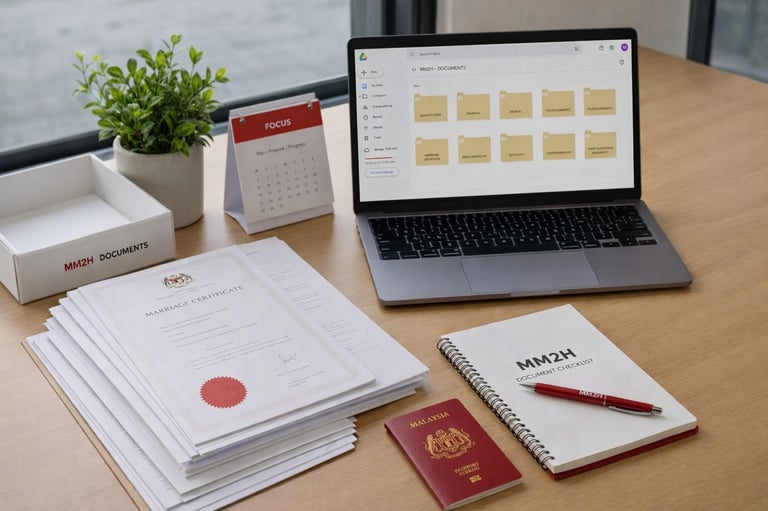
Paperwork is the next hurdle. The Ministry of Tourism, Arts and Culture (MOTAC) publishes a checklist that spells out every original, hard‑copy document you must submit. You can download the official list here: MOTAC checklist. It includes passport copies, birth certificates, marriage certificates (if applicable), medical reports, bank statements and proof of the fixed deposit.
Each document must be certified by the Malaysian embassy or consulate in your home country. Translation into Bahasa Malaysia or English is required if the original is not in one of those languages.
Here’s a quick way to stay organized:
Make a master folder on your computer named MM2H Docs.
Create sub‑folders for Identity, Financial, Health and Family.
Label every file with the date you received the certified copy.
Missing a single signature can send your file back for correction, so double‑check each page.
We often see applicants forget the insurance policy document. That paper proves you have medical coverage for the first year, a requirement for anyone under 60.
Once you have everything, scan each file at 300 dpi and store the PDFs in a secure cloud folder. Share the folder with your MM2H agent so they can upload it to the portal.
Step 3: Submit Application & Pay Fees
Now the files are ready, it’s time to submit. Your authorized MM2H agent will upload everything to the immigration portal and create a conditional approval letter.
The government fees are tier‑specific and one‑off. MM2H’s official fee schedule shows RM40,000 for Silver, RM55,000 for Gold and RM70,000 for Platinum. Those numbers cover processing, the visa itself and the first year of medical insurance.
Payment works in stages. You put down 10 % when you start, another 10 % when the documents go in, and the remaining 80 % when the visa is ready to be collected. Paying early avoids the common bottleneck where agents wait for funds before sending the file.
Keep a copy of every receipt. The immigration office may ask for proof of payment before they stamp your passport.
Here’s a simple timeline you can print:
Deposit 10 % → start the file.
Submit docs → pay another 10 %.
Receive conditional letter → pay the final 80 %.
Once the fee is settled, the government issues a conditional approval letter. That letter is your green light to move to the next steps.
Step 5: Receive Visa Approval & Prepare Arrival
When the immigration office finishes its review, they will endorse your passport with a social‑visit pass. The pass is renewable , five years for Silver, fifteen for Gold and twenty for Platinum.
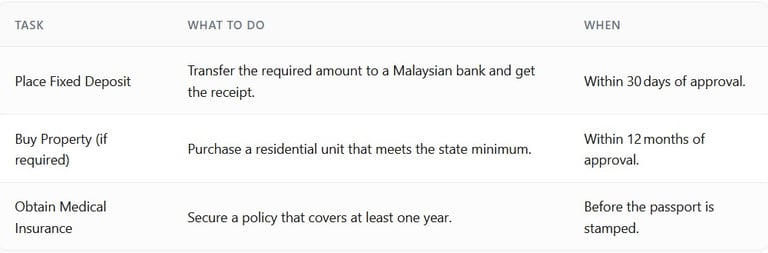
Before you collect the passport, you must complete three final tasks:
Pro Tip: Open a local bank account early; most banks need the conditional approval letter to process the fixed‑deposit.
FAQ
What age groups are eligible for the MM2H program?
Applicants of any age can apply, but those 51 and older are exempt from the 90‑day‑per‑year stay rule. Younger applicants must log at least 90 days each year, and that record can be checked by immigration. The age cut‑off is a key part of the mm2h requirements and makes the program attractive for retirees.
How much money do I need for the fixed deposit?
The deposit amount depends on the tier you choose. Silver starts at US$150 k (some guides list US$500 k), Gold requires US$500 k and Platinum asks for US$1 M. The money sits in a Malaysian bank and you can withdraw up to 50 % for approved expenses like property purchase, education or medical costs.
Do I need to buy a property in Malaysia?
All tiers except the Sarawak option require you to purchase a residential property within one year of approval. State limits differ , Kuala Lumpur asks for at least RM1 M, while Selangor expects RM2 M. The property must be owned outright; you can sell it later but must hold it for ten years unless you upgrade.
What are the government fees I must pay?
Fees are tier‑specific and one‑off: RM40 k for Silver, RM55 k for Gold and RM70 k for Platinum. They cover processing, the visa itself and the first year of mandatory medical insurance for applicants under 60. Payments are split into 10 % at start, 10 % when documents are filed and the remaining 80 % before you collect the passport.
How long does the whole process take?
From the moment you submit a complete file to receiving the stamped passport, the timeline is typically three to four months. The conditional approval letter usually arrives within 8‑12 weeks, then you have about three months to place the fixed deposit, buy property and secure insurance before the visa is endorsed.
Can my spouse and children join me?
Yes. A spouse, children under 34 (who are not working in Malaysia), disabled children of any age, and parents or parents‑in‑law can be listed as dependents. They do not need a separate fixed deposit, but they must pass the health check and provide the same certified documents.
What happens after the visa is granted?
The visa is a renewable social‑visit pass. You must keep the fixed deposit in place and maintain the property ownership. Every renewal may require proof of the deposit and property, plus a fresh health check if you’re over 60. Staying compliant ensures you can keep your long‑term residency without interruption.
Do I need to work in Malaysia to keep the visa?
No. The MM2H visa does not grant work rights. Only the Platinum tier allows limited work permits, and even then you need a separate employment pass. Most holders use the visa for retirement, remote work or investment purposes.
Conclusion
Getting the MM2H visa is a series of clear steps: confirm you meet the age and financial thresholds, gather every certified document, pay the tier‑specific fees, attend the interview and health check, then seal the deal with the final approval. The process may feel detailed, but each piece fits into a logical flow.
When you follow the checklist, you avoid the common pitfalls that cause delays , missing a signature, overlooking the insurance paper or waiting too long to place the fixed deposit. With the right preparation, the program opens the door to a long‑term stay in a vibrant, affordable country.
Ready to explore the next stage? Our guide on Malaysia My Second Home (MM2H) walks you through lifestyle benefits, tax considerations and how to pick the right property in KLCC.
We’re here to help you turn the paperwork into a smooth journey. Let’s make your second home a reality.
Key Takeaway: Age over 50 removes the 90‑day stay rule; pick the tier that fits your deposit size.

Step 4: Attend Interview & Health Check
The conditional approval letter tells you to appear in Malaysia for an interview and a medical exam. The interview is brief, an officer checks your intent, your financial proof and asks about family members.
The health check must be done by a government‑approved clinic. It includes blood work, a chest X‑ray and a general physical. If you’re under 60, you also need to buy the first year of medical insurance; the insurer will forward proof to the immigration office.
Plan your trip wisely. You only need to stay for a few days, but you must bring original documents for verification. The officer will look at your passport, the conditional letter, the fixed‑deposit receipt and the insurance policy.
After the interview, the doctor issues a health‑clearance certificate. That certificate, along with the original documents, goes back to the immigration office for final stamping.
Many applicants worry about the travel cost. Remember, you only need to be in Malaysia once before the visa is endorsed, and you have up to three months to complete the post‑approval steps.
Key Takeaway: After approval, you have three weeks to place the FD, buy property and secure insurance before the passport is stamped.
Once those boxes are ticked, you collect your passport. The visa lets you enter and leave Malaysia as often you like. You won’t need a work permit unless you apply for a separate employment pass.
Now think about settling in. KLCC Investor can help you find a luxury condo in the city centre, handle the bank account set‑up for the fixed deposit, and even arrange school tours if you have kids.
Keep a digital copy of the visa page and store the physical passport in a safe place. The government may ask for proof of residency or property ownership during renewal, so keep those records handy.